
You’ve chosen your wedding invitations, finalized the guest list, and found the perfect envelopes. Now comes a surprisingly important task: figuring out exactly whose names belong on each one.
Knowing how to address wedding invitations can make your guests feel personally welcomed while avoiding awkward mistakes about partners, children, and additional guests.
Traditional wedding etiquette offers useful guidance, but modern invitations allow greater flexibility. The best approach is to respect each person’s preferred name while keeping the mailing address accurate.
This guide explains how to address wedding envelopes for couples, families, single guests, and different household arrangements, with examples you can adapt to your celebration.
Why Wedding Invitation Addressing Matters
An invitation envelope does more than carry stationery. It communicates who is invited and establishes the tone of the celebration.
For example, addressing an envelope to a couple without mentioning their children may suggest that the invitation is intended only for the adults.
Likewise, including “and Guest” indicates that someone may bring an additional person.
Clear addressing prevents misunderstandings before they become uncomfortable conversations.
Outer vs. Inner Wedding Invitation Envelopes
Traditional wedding invitation suites may include two envelopes, although many modern couples use only one.
Outer Envelope
The outer envelope carries the mailing address and identifies the recipient.
It typically includes the guest’s full name, street address, city, and postal code.
Formal celebrations may use titles such as Mr., Mrs., Ms., or Dr., depending on the guest’s preferences.
Inner Envelope
An inner envelope sits inside the mailing envelope and identifies exactly who is invited.
It may use a more relaxed form of address.
For example:
Outer envelope: Alexandra Morgan and Taylor Rivera
Inner envelope: Alexandra and Taylor
If children are invited, their names can appear on the inner envelope below their parents’ names.
When using only one envelope, make sure the invitation clearly identifies every invited guest.
How to Address Wedding Invitations to Married Couples
For married couples sharing a surname, you can use a traditional or contemporary format.
Traditional example:
Mr. and Mrs. Daniel Parker
Modern example:
Daniel and Sophia Parker
The modern version recognizes both partners by their first names.
For married couples with different surnames, write both names.
Example:
Sophia Bennett and Daniel Parker
You don’t need to follow a fixed order. Choose the arrangement that suits the couple’s preferences and your invitation style.
How to Address Unmarried Couples
For unmarried partners living together, include both people’s names on the envelope.
Example:
Olivia Carter and Ethan Brooks
For a formal invitation, you may place the names on separate lines.
If partners live at different addresses, consider sending individual invitations when appropriate.
Avoid assuming that sharing an address means people are romantically involved. Confirm relationships before completing your guest list.
How to Address Wedding Invitations to Single Guests
Single guests should be addressed using their preferred names and titles.
Examples include:
- Ms. Emma Wilson
- Mr. James Carter
- Dr. Avery Thompson
- Jordan Mitchell
Titles are optional for many contemporary weddings.
If you don’t know someone’s preferred title, using their full name without one is a respectful alternative.
What About Plus-Ones?
If a guest is allowed to bring someone and you know the person’s name, include it.
Example:
Emma Wilson and Jordan Lee
If the additional guest hasn’t been chosen, you can write:
Emma Wilson and Guest
Only include a plus-one when you’ve decided to offer one.
How to Address Wedding Invitations to Families
Family invitations require particular care because the wording should reflect which household members are welcome.
When the entire household is invited, a casual invitation might use:
The Mitchell Family
For greater clarity, especially with formal events, list the invited adults and children individually.
Example:
Daniel and Sophia Mitchell
Lily Mitchell and Noah Mitchell
This avoids confusion when the wedding has age restrictions or limited seating.
Adult children living separately should generally receive their own invitations.
How to Address Wedding Invitations to Doctors and Professionals
Professional titles may be appropriate for formal celebrations, especially when recipients regularly use them.
For example:
Dr. Olivia Bennett and Mr. Daniel Parker
Or:
Dr. Olivia Bennett and Dr. Daniel Parker
Use the title associated with each person’s actual role and preference.
You can also omit professional titles entirely for an informal wedding.
The important thing is consistency and respect, rather than following outdated rules automatically.
How to Address Same-Sex and Nonbinary Couples
The same principles apply to every couple: use the names and titles each person prefers.
Example:
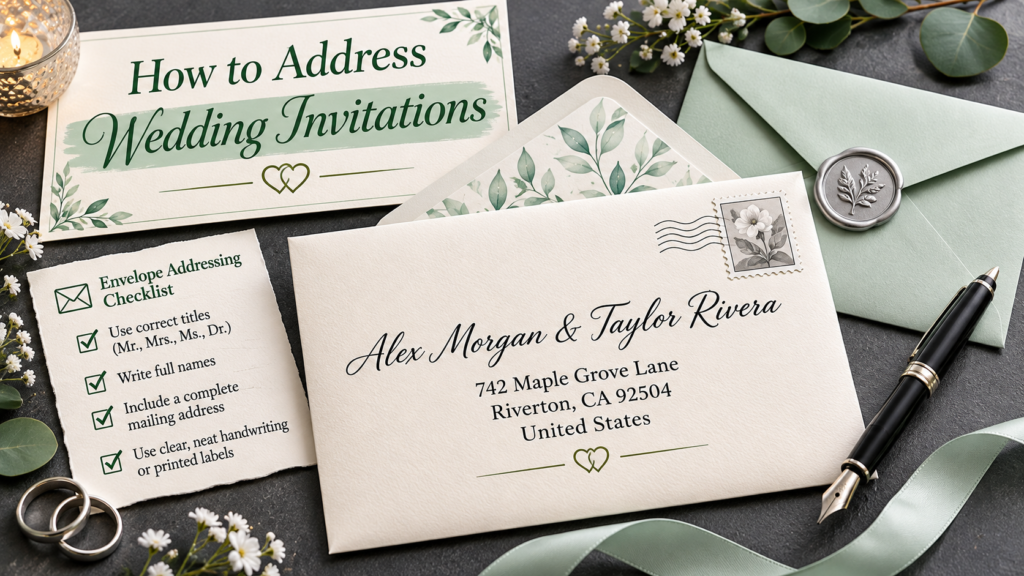
Alex Morgan and Taylor Rivera
You can use full names without gendered titles, or include titles such as Mx. when requested.
Neither partner needs to be listed first because of gender.
A simple confirmation of name spelling and preferences is often more thoughtful than guessing.
How to Address Wedding Invitations in the UK and USA
Wedding etiquette and postal formatting are related but separate concerns.
Decorative name styling is a personal choice. The delivery address, however, should follow the postal requirements of the destination country.
UK Wedding Invitation Address Format
A UK mailing address normally follows this structure:
Recipient’s Full Name
House Number and Street
Town or City
Full Postcode
Write the post town and postcode clearly. Keeping address lines left-aligned can improve readability.
USA Wedding Invitation Address Format
A typical US envelope uses:
Recipient’s Full Name
Street Address and Apartment Number
City, State Abbreviation, ZIP Code
The delivery address should be easy to read, with the return address placed in the upper-left area of the envelope.
For international wedding invitations, include the destination country on the final line and verify the country’s preferred postal format.
Handwritten vs. Printed Wedding Envelope Addresses
Handwritten envelopes bring a traditional, personalized appearance to wedding stationery.
Calligraphy can be especially beautiful for formal invitations, but readability should always come first.
Printed labels or directly printed envelopes are practical alternatives when you have a large guest list.
For a modern minimalist wedding, a clean printed font may actually complement the design better than elaborate lettering.
Whatever method you choose, leave sufficient space around the address and use strong color contrast.
A Simple Two-Pass Guest List Check
Before addressing dozens of envelopes, separate your review into two stages.
First pass: Check the people.
Confirm preferred names, surnames, titles, invited partners, and children.
Second pass: Check the delivery.
Confirm street numbers, apartment information, postal codes, and destination countries.
This prevents a common problem: beautifully printed envelopes with the correct guest names but incomplete addresses.
If you organize several celebrations, the same attention to clear names and invitations can help with other events. Our baby shower invitation wording guide offers message examples and practical invitation details for family celebrations.
Common Wedding Invitation Addressing Mistakes
Small addressing mistakes can lead to confusion or delivery problems.
Avoid guessing whether someone has changed their surname after marriage.
Don’t assume a guest wants a traditional title, and never add an unapproved plus-one.
Check that apartment numbers and postcodes are included.
Finally, avoid decorative handwriting that makes the address difficult for postal workers to read.
A beautiful envelope should still function as a reliable piece of mail.
Frequently Asked Questions
How do you properly address a wedding invitation?
Write the invited person’s full name and complete mailing address. Use titles where appropriate and make sure the envelope clearly identifies everyone invited.
Do you have to use Mr. and Mrs.?
No. Modern wedding invitations can use full names without titles. Respecting guests’ preferences is more important than following one formal convention.
How do you address an invitation to a couple with different last names?
Include both names, such as “Olivia Bennett and Daniel Parker,” using whichever name order the couple prefers.
Can wedding invitation addresses be printed?
Yes. Printed addresses are acceptable and often easier to read. Choose clear typography and a suitable envelope color.
Should children be named on wedding invitations?
If children are invited, naming them or otherwise making their inclusion explicit helps prevent misunderstandings.
Final Thoughts
Learning how to address wedding invitations becomes much easier when you focus on three things: respecting guests’ identities, identifying exactly who is invited, and ensuring accurate delivery information.
Traditional etiquette can guide your choices, but it doesn’t need to restrict your personal style.
Whether you choose handwritten calligraphy or modern printed envelopes, thoughtful addressing creates a welcoming first impression and helps your celebration begin on the right note.