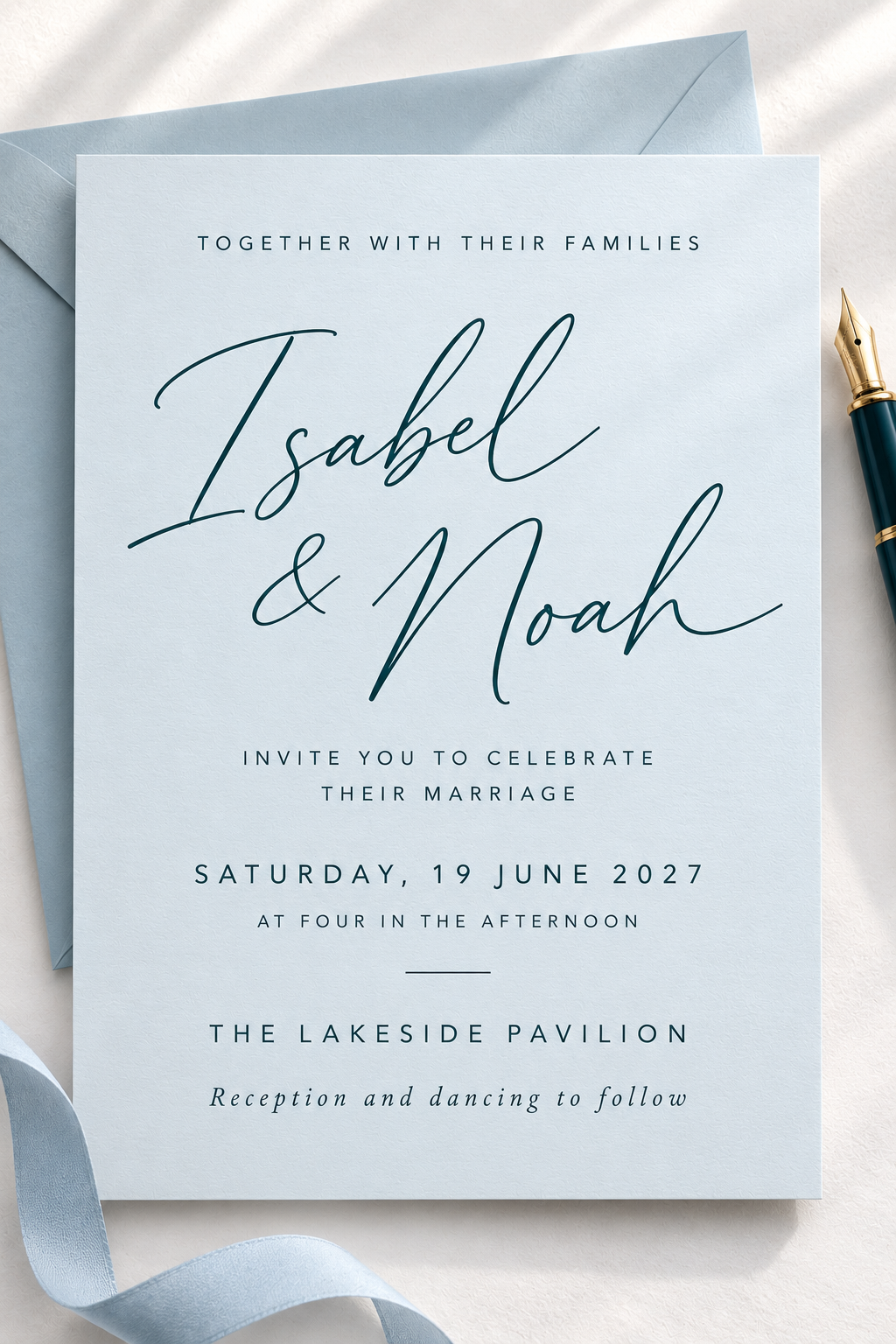
There is something particularly personal about seeing two names written by hand on a wedding invitation. The gentle curves, irregular strokes and natural movement of the lettering can make even the simplest card feel like a keepsake.
A minimalist wedding invitation design with handwritten couple names places that personal connection at the heart of the stationery. Instead of relying on elaborate patterns, floral borders or decorative illustrations, it allows the names to tell their own visual story.
Whether you prefer authentic handwriting, elegant calligraphy or a carefully selected signature font, this design approach offers a beautiful way to introduce your wedding celebration.
Let Your Names Become the Artwork
When handwritten lettering becomes the central feature of an invitation, there is little need for additional decoration.
The natural movement of a handwritten name creates visual interest, while the surrounding empty space allows every curve and stroke to stand out.
Begin by placing both names on a plain background. Experiment with their position, size and relationship before introducing any other text.
The names should feel connected without necessarily touching. A small ampersand, a simple handwritten “and” or a carefully positioned line break can bring them together.
This approach is particularly suitable for intimate ceremonies, modern registry office weddings, countryside celebrations and contemporary receptions.
Authentic Handwriting or a Script Font?
There are several ways to achieve a handwritten appearance, and each offers a slightly different result.
| Lettering method | Appearance | Best suited to |
|---|---|---|
| Personal handwriting | Natural and individual | Intimate weddings |
| Custom calligraphy | Refined and expressive | Formal celebrations |
| Signature font | Modern and flowing | Contemporary weddings |
| Casual handwritten font | Relaxed and approachable | Informal ceremonies |
| Monoline lettering | Clean and consistent | Geometric minimalist stationery |
Authentic handwriting preserves the individuality of each person’s writing style. A digital script font, meanwhile, offers a convenient way to maintain consistent lettering across an entire wedding stationery collection.
If you commission a calligrapher, discuss how the lettering will be supplied and whether you may reproduce it on other stationery.
Create a Wedding Invitation Using Your Own Handwriting
You do not need professional calligraphy skills to introduce genuine handwritten names into your invitation.
Ordinary handwriting can become a meaningful design element when it is carefully prepared.
Capture the Names
Write both names several times using a dark pen on plain white paper. Experiment with different letter sizes and spacing.
Choose versions that look natural rather than selecting the most elaborate ones.
Convert the Handwriting Into Digital Artwork
Scan the paper at approximately 600 PPI or photograph it in even lighting.
Crop the selected names, adjust the contrast and remove the background using suitable image-editing software. Save the artwork as a transparent PNG, or convert it into vector artwork for easier resizing.
Preserve the Natural Details
Avoid smoothing every irregularity. Small variations in stroke thickness and letter shapes contribute to the character of genuine handwriting.
Retain enough detail for the names to remain clear when printed.
Finally, place the lettering into your invitation layout and compare different sizes before adding the ceremony information.
For privacy, create decorative versions of your names rather than reproducing signatures used on legal or financial documents.
Three Personalised Layouts Worth Exploring
Two Names, Two Handwriting Styles
Ask each partner to write their own name. Position the names on separate lines and connect them with a small ampersand.
The contrast between two writing styles becomes part of the invitation’s identity.
Keep the remaining information in a neutral typeface so the personal lettering receives the attention it deserves.
The Flowing Signature Line
Arrange both names across the middle of a landscape invitation using graceful, flowing script.
Leave generous space around long strokes and extended letter endings. This composition works well when the names have similar lengths.
For longer names, use a slightly larger card rather than squeezing the lettering into a narrow space.
The Handwritten Note Concept
Create an invitation inspired by the simplicity of a personal letter.
Place a short welcoming message at the top, followed by the couple’s handwritten names and a neatly arranged ceremony information block.
A soft paper texture and restrained colours can complement this design without making it appear overly decorative.
Colour Palettes That Complement Handwritten Lettering
The colour of the lettering should support its delicate details. Darker ink against a pale background generally makes fine strokes easier to distinguish.
| Colour combination | Background | Lettering |
|---|---|---|
| Contemporary coastal | Powder blue #E4EEF3 | Deep teal #234B53 |
| Natural elegance | Oatmeal #F4EFE5 | Espresso #503B32 |
| Soft romance | Pale peach #F9E5DC | Wine red #83394A |
| Modern luxury | Warm ivory #FAF7F0 | Charcoal #292929 |
| Countryside charm | Soft buttercream #F9F2D6 | Moss green #536044 |
Powder blue and deep teal are particularly attractive for couples seeking a fresh alternative to traditional cream-and-black invitations.
Request a printed sample if accurate colour reproduction matters, especially when using textured paper.
Choosing Supporting Fonts for Handwritten Names
The most expressive lettering should be reserved for the couple’s names. Practical information requires a quieter, more readable typeface.
Allura paired with DM Sans can create a light, romantic appearance. Great Vibes and Libre Baskerville provide a more traditional combination, while Sacramento and Montserrat offer a relaxed contemporary style.
Test the actual names before selecting a script font. Some fonts have attractive sample lettering but less readable capital letters or awkward connections between particular characters.
If you are exploring different stationery arrangements, our wedding invitation templates can provide useful layout inspiration.
Sample Wedding Invitation Wording
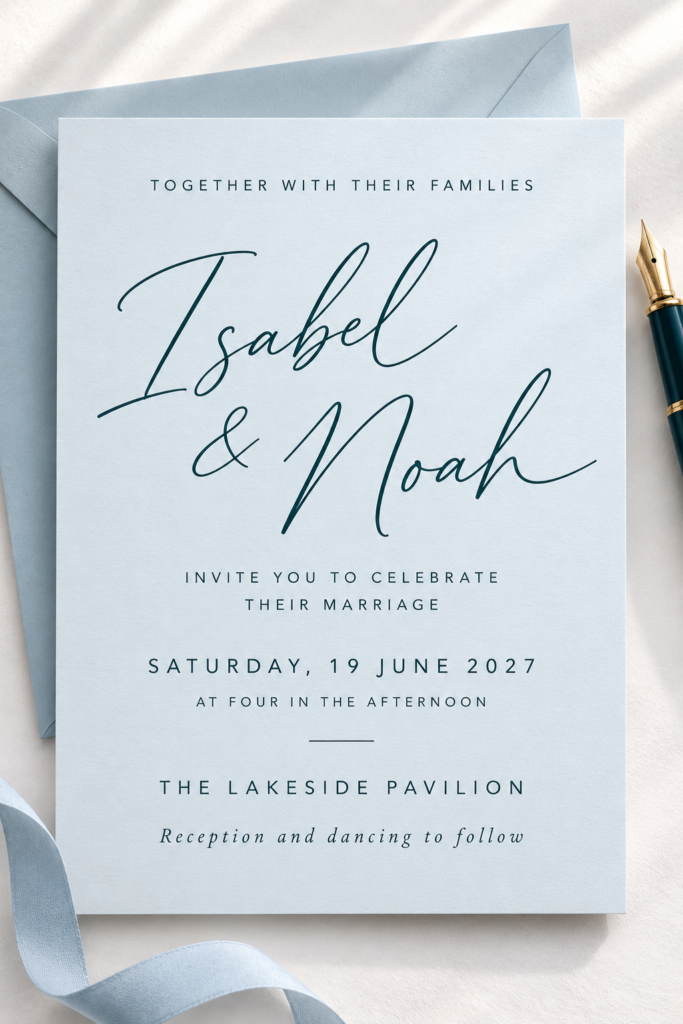
This fictional example demonstrates how handwritten names can complement simple wedding wording.
Together with their families
Isabel & Noah
Invite you to celebrate their marriage
Saturday, 19 June 2027
At four in the afternoon
The Lakeside Pavilion
Reception and dancing to follow
Place the names in flowing handwritten-style lettering and keep the remaining details in a clean typeface.
American couples may prefer June 19, 2027, while the day-month-year arrangement is familiar to British audiences. Writing the month in full helps international guests interpret the date correctly.
The Name Readability Test
Before finalising your invitation, show the design to someone unfamiliar with the names.
Ask them to read both names without providing any hints. If they hesitate over a capital letter or confuse overlapping strokes, adjust the lettering.
Check lowercase letters, extended flourishes and the spacing around the ampersand.
Avoid using script lettering for addresses, RSVP deadlines or other essential details.
You can explore alternative compositions using our invitation card maker.
Preparing Handwritten Invitations for Printing
A 5 × 7-inch portrait invitation offers a practical starting point. However, landscape formats may suit exceptionally long names.
Keep important lettering inside the printer’s safe area, and aim for 300 PPI at the final print size when using raster artwork.
Smooth matte cardstock can preserve delicate strokes more clearly than heavily textured surfaces. Ask your printer about minimum reproducible line thickness for foil or letterpress finishes.
Export the design according to your printer’s PDF requirements and prepare a separate high-resolution image for digital sharing.
Carry the personalised lettering across your save-the-date cards and reception stationery. Our guide to wedding invitation suites offers further coordination ideas.
Frequently Asked Questions
Can handwritten names look professional on wedding invitations?
Yes. Balanced spacing, consistent colours and readable supporting typography can give handwritten lettering a polished appearance.
Do both names need the same handwriting style?
No. Combining two distinct personal handwriting styles can make the invitation more meaningful. Adjust their relative sizes to maintain visual balance.
Are handwritten wedding invitations suitable for formal celebrations?
Yes. Refined calligraphy, high-quality paper and restrained colour combinations work beautifully for formal wedding stationery.
Make Simplicity Personal
A minimalist wedding invitation does not have to feel impersonal. Handwritten couple names introduce warmth, individuality and a meaningful connection to the people behind the celebration.
Whether you choose authentic handwriting or digital calligraphy, give the names enough space to remain expressive. Keep the ceremony information clear and allow the personal lettering to become the defining feature of your wedding invitation.