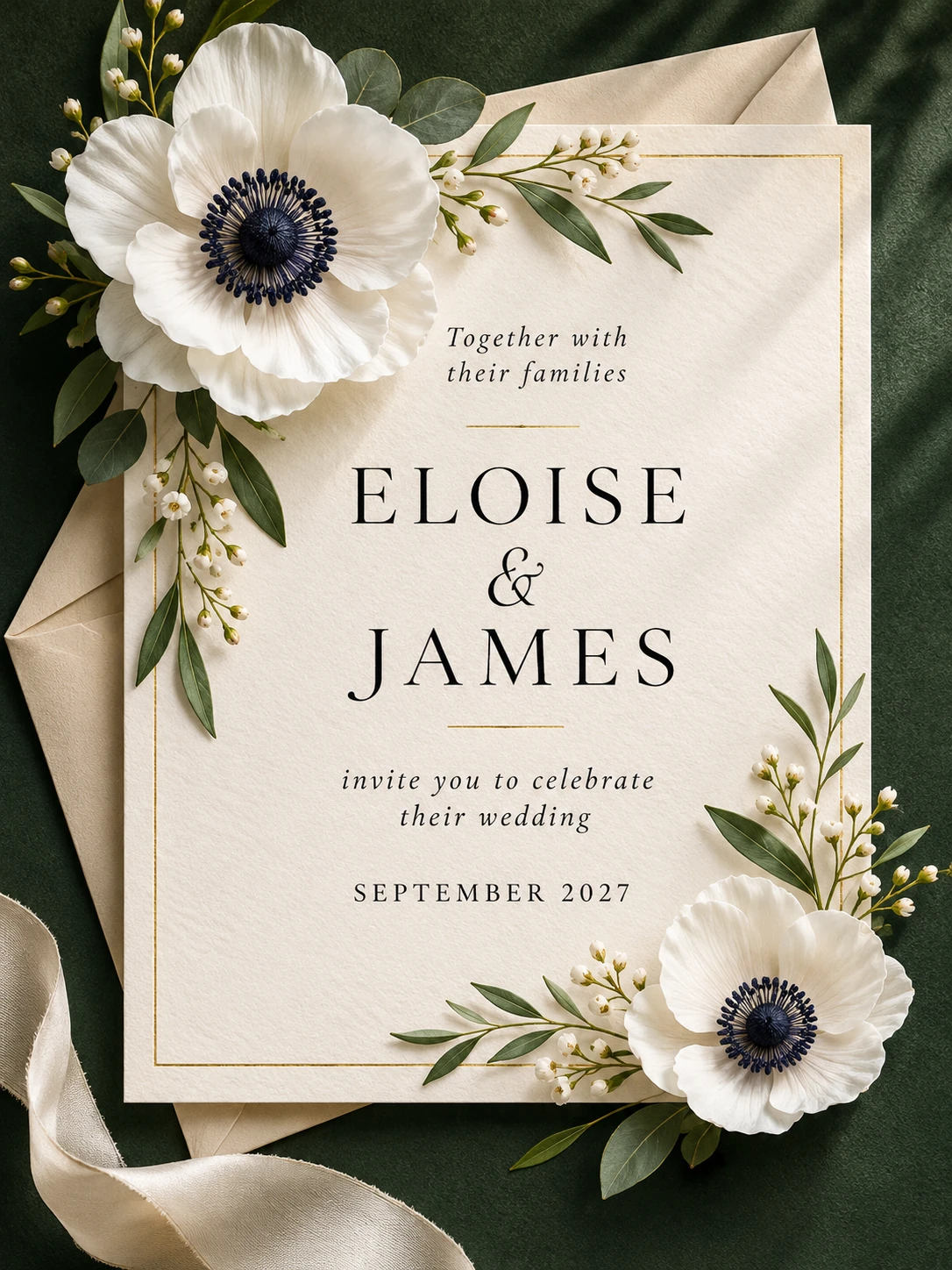
Some wedding flowers whisper romance. White anemones make a statement.
Their delicate, almost translucent petals surround a dramatic dark centre, creating a natural contrast that feels both romantic and contemporary. On wedding stationery, this combination can look striking without requiring elaborate borders, metallic decorations, or complicated typography.
A floral wedding invitation design with white anemones is particularly appealing to couples who want botanical elegance with a modern personality. Whether the celebration takes place in a garden, a historic venue, or a contemporary city setting, these distinctive flowers can help establish a memorable visual theme.
The challenge is making the invitation feel thoughtfully designed rather than simply adding flowers around a standard template.
Here is how to achieve that balance.
The Distinctive Beauty of White Anemone Wedding Invitations
White anemones have a visual feature that many softer floral illustrations lack: a naturally strong focal point.
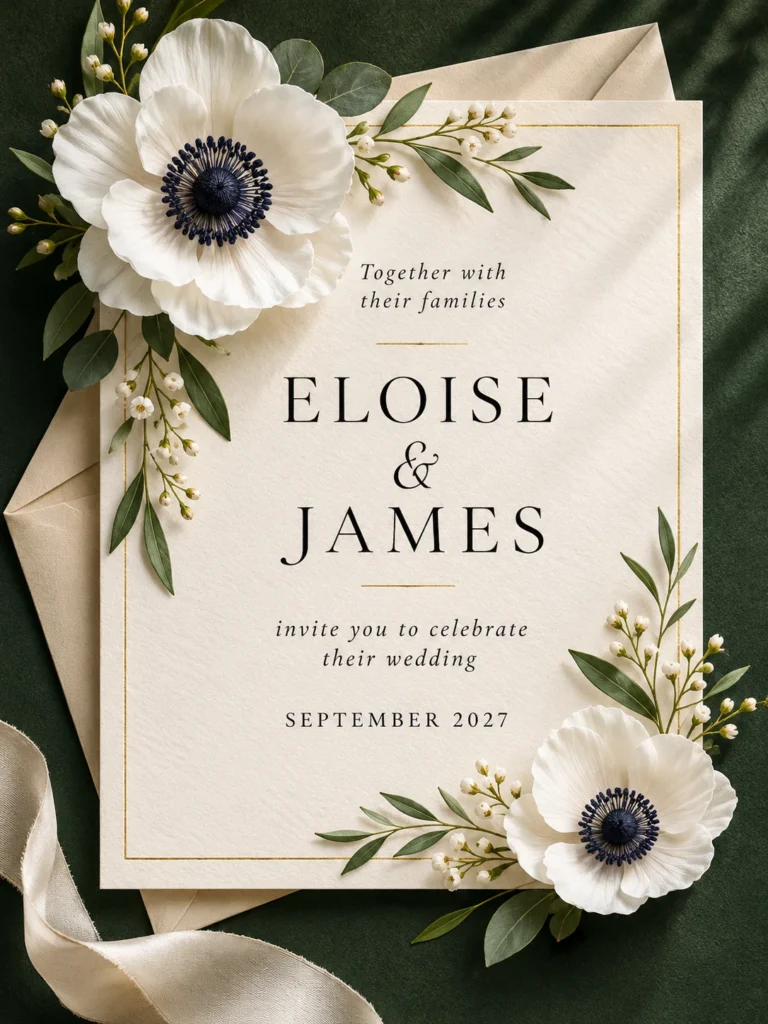
Their pale petals contrast with a dark central disc and surrounding stamens. Depending on the variety and illustration style, the centre may appear deep navy, violet-black, or charcoal.
This contrast gives designers an opportunity to coordinate the flowers with the invitation’s lettering.
For example, dark charcoal typography can echo the centre of an anemone, while ivory cardstock complements its petals.
The result is a cohesive botanical composition rather than a collection of unrelated decorative elements.
White anemones are also different from daisies, which commonly feature golden-yellow centres. That distinction makes them especially interesting for sophisticated monochrome wedding stationery.
Three Creative Ways to Design White Anemone Wedding Invitations
1. The Asymmetrical Botanical Gallery
Instead of surrounding the invitation with a conventional floral frame, position a single oversized white anemone near the upper-left edge.
Allow a few petals to extend beyond the printed border.
Arrange the couple’s names in a generous column on the right, leaving uninterrupted space around the ceremony details.
Add a tiny anemone bud beneath the RSVP information to connect the top and bottom of the design.
This creates a gallery-inspired layout that feels artistic without sacrificing readability.
A combination of off-white paper, graphite lettering, and muted olive foliage works particularly well.
2. The Frosted Vellum Invitation
For something tactile, introduce a translucent vellum layer.
Print anemone illustrations on a warm ivory backing card, then place the wedding wording on a separate vellum overlay.
The flowers become softly diffused beneath the transparent surface, creating depth without adding visual clutter.
Choose dark ink for the names and essential details, particularly where the artwork appears underneath.
A narrow forest-green ribbon or simple paper band can hold the two layers together.
This approach is suitable for couples who appreciate understated luxury and layered wedding stationery.
3. The Midnight Botanical Invitation
White flowers do not always need a white background.
Imagine an invitation with a deep forest-green or midnight-blue background, featuring two carefully illustrated anemones.
Their creamy petals appear luminous against the darker surface.
Use warm ivory text and a subtle antique-gold accent for the date or a decorative separator.
Avoid adding gold to every heading. A restrained metallic detail creates a more considered appearance.
This direction suits evening weddings, formal receptions, and modern botanical celebrations.
Building a Colour Palette Around White Anemones
The colour palette should support the flowers rather than compete with them.
Three combinations worth exploring are:
- Ivory, forest green, and charcoal: A botanical palette that feels calm, polished, and timeless.
- Champagne, soft taupe, and midnight blue: A refined combination suitable for formal wedding invitations.
- Pearl white, dusty mauve, and deep plum: A softer romantic interpretation with an unexpected dark accent.
Try coordinating the darkest text colour with the anemone’s centre. This small decision can make separate design elements feel intentionally connected.
For additional background combinations, explore our invitation background ideas.
A Practical Design Method: The Anemone Contrast Test
One useful technique is to evaluate the invitation in three stages before printing.
First, temporarily convert the design to greyscale. Check whether the couple’s names and wedding date remain easy to identify.
Second, view the invitation at approximately the size it will appear on a smartphone. Fine floral outlines can disappear when artwork is reduced.
Third, temporarily hide the flowers. The remaining text should still have a clear hierarchy.
If the invitation becomes confusing without its decorative elements, the typography may need improvement.
This process helps separate attractive decoration from functional communication.
Elegant White Anemone Wedding Invitation Wording
A botanical wedding invitation does not require complicated poetry. Simple, personal wording often complements sophisticated artwork more effectively.
Consider this example:
A Modern Romantic Invitation
An Evening in Bloom
Eloise & James
Together with their families,
joyfully invite you to celebrate
their wedding.
[Day and Wedding Date]
[Ceremony Time]
[Wedding Venue]
[Full Venue Address]
Dinner and celebration to follow.
Kindly RSVP by [Date].
This wording creates a gentle floral connection while keeping the practical information prominent.
For alternative formal, informal, and family-hosted wording, browse our wedding invitation templates.
Choosing Paper, Typography, and Finishing Details
Paper That Complements White Petals
Warm ivory or lightly textured cotton cardstock can create a natural setting for white anemone artwork.
Smooth matte paper is another attractive choice, particularly for invitations featuring crisp botanical illustrations.
Before selecting textured paper, request a printed proof. Heavy texture can affect the appearance of fine details and small lettering.
Typography with Personality
Pair a refined serif typeface with a clean sans-serif font.
The serif can highlight the couple’s names, while the simpler font handles the ceremony details and RSVP instructions.
Avoid using several competing script fonts. The floral illustrations already provide visual character.
Finishing the Invitation Suite
Consider carrying a simplified anemone motif onto the RSVP card, envelope liner, or wedding menu.
Rather than repeating the complete illustration, use a single petal outline or miniature flower.
Couples interested in a more natural, handcrafted look can also explore our pressed wildflower wedding invitation designs.
Preparing Your Invitation for Print and Digital Sharing
A 5 × 7-inch card is a familiar invitation format for US weddings, while A6 and other custom sizes are also commonly used by UK stationery printers.
For printed raster artwork, 300 pixels per inch at the final print dimensions is a practical target.
Keep important lettering away from trimming edges and confirm bleed specifications with your printer.
For digital invitations, prioritise larger text, a clearly organised date and venue, and sufficient contrast between flowers and lettering.
If guests are located internationally, clearly state the venue’s city and country. For online ceremonies, include the relevant time zone.
Always review the final invitation on both desktop and mobile devices before sharing.
Frequently Asked Questions
Are white anemones suitable for modern wedding invitations?
Yes. Their clean petals and striking dark centres make them particularly suitable for minimalist, monochrome, and contemporary botanical invitation styles.
What colours complement white anemone wedding stationery?
Forest green, charcoal, midnight blue, champagne, soft taupe, and muted plum can all complement white anemones. The best choice depends on the atmosphere of your celebration.
Can I create a minimalist invitation using only one anemone?
Absolutely. One carefully positioned flower, generous negative space, and elegant typography can create an effective minimalist design.
Are white anemone invitations suitable for digital weddings?
Yes. Botanical illustrations can work beautifully in digital invitations when image quality, contrast, and text readability are preserved.
Final Thoughts
White anemones offer something distinctive: softness and dramatic contrast within the same flower.
Whether you choose an asymmetrical botanical layout, translucent vellum layers, or a dark contemporary background, the most effective invitation will balance floral beauty with clear, readable information.
Allow the flowers to establish the atmosphere, the typography to tell your story, and the thoughtful finishing details to make the design your own.
A beautiful invitation should do more than announce a date. It should offer guests their first glimpse of the celebration to come.