A single flower drawn in fine ink can give a wedding invitation a sense of quiet romance. Without colourful bouquets, elaborate patterns or decorative frames, its simple outline becomes a distinctive feature that guests can associate with the celebration.
A minimalist wedding invitation design with single floral line drawing is ideal for couples who appreciate artistic simplicity and meaningful details. The illustration might represent a flower from the bridal bouquet, a favourite garden plant or a bloom associated with a special memory.
The beauty of this approach lies in choosing one thoughtful illustration and allowing the rest of the invitation to complement it.
Begin With a Flower That Means Something
Rather than selecting floral artwork simply because it looks attractive, consider how the flower relates to your wedding.
A calla lily can complement a contemporary ceremony, while a rose outline introduces a more traditional romantic character. A tulip may suit a spring celebration, and a delicate cosmos flower can feel at home in an informal garden setting.
The illustration does not need to match the wedding flowers exactly. However, creating a connection between the invitation and the celebration can make the stationery feel more personal.
| Flower illustration | Visual character | Suitable wedding style |
|---|---|---|
| Calla lily | Sculptural and graceful | Contemporary wedding |
| Single rose | Romantic and familiar | Classic ceremony |
| Tulip | Clean and understated | Spring wedding |
| Cosmos | Light and delicate | Garden celebration |
| Magnolia | Refined and expressive | Elegant formal wedding |
| Poppy | Artistic and distinctive | Creative outdoor wedding |
These associations are design suggestions rather than fixed rules about flower symbolism.
Continuous Line Art or Fine-Line Botanical Drawing?
Although both styles can produce minimalist floral wedding invitations, they have different visual qualities.
A continuous line drawing creates an illustration using one uninterrupted stroke. Its abstract appearance works particularly well with modern typography and generous negative space.
Fine-line botanical artwork may use several individual strokes to describe the petals, stem and leaves more accurately. This creates a recognisable flower while preserving an understated appearance.
A single floral illustration does not have to be a continuous-line drawing. The defining feature is that one flower becomes the main decorative element.
Choose the approach that suits your wedding personality rather than following a particular design trend.
Three Ways to Position a Single Flower
The Tall Stem Along the Edge
Place a slender flower illustration vertically along the right-hand side of the invitation.
Arrange the couple’s names and wedding information in the remaining space. The stem creates a natural visual boundary without requiring a printed frame.
A calla lily or tulip works particularly well because of its recognisable elongated shape.
The Floating Flower Head
Position a small flower outline above the couple’s names, leaving the stem out entirely.
This creates a delicate decorative accent that resembles an understated emblem. It is especially useful for smaller wedding cards where a large botanical illustration would compete with essential information.
The Bottom-Corner Sketch
Begin the stem near the lower corner and let the flower extend gently towards the centre.
Keep the illustration clear of the date, venue and RSVP details. This arrangement introduces movement without surrounding the entire invitation with decorative artwork.
You can compare different compositions using our wedding invitation templates.
An Original Design Concept: Buttercream and Plum
Traditional floral wedding stationery often uses green, white and blush tones. A soft buttercream background with dark plum line art offers a distinctive alternative.
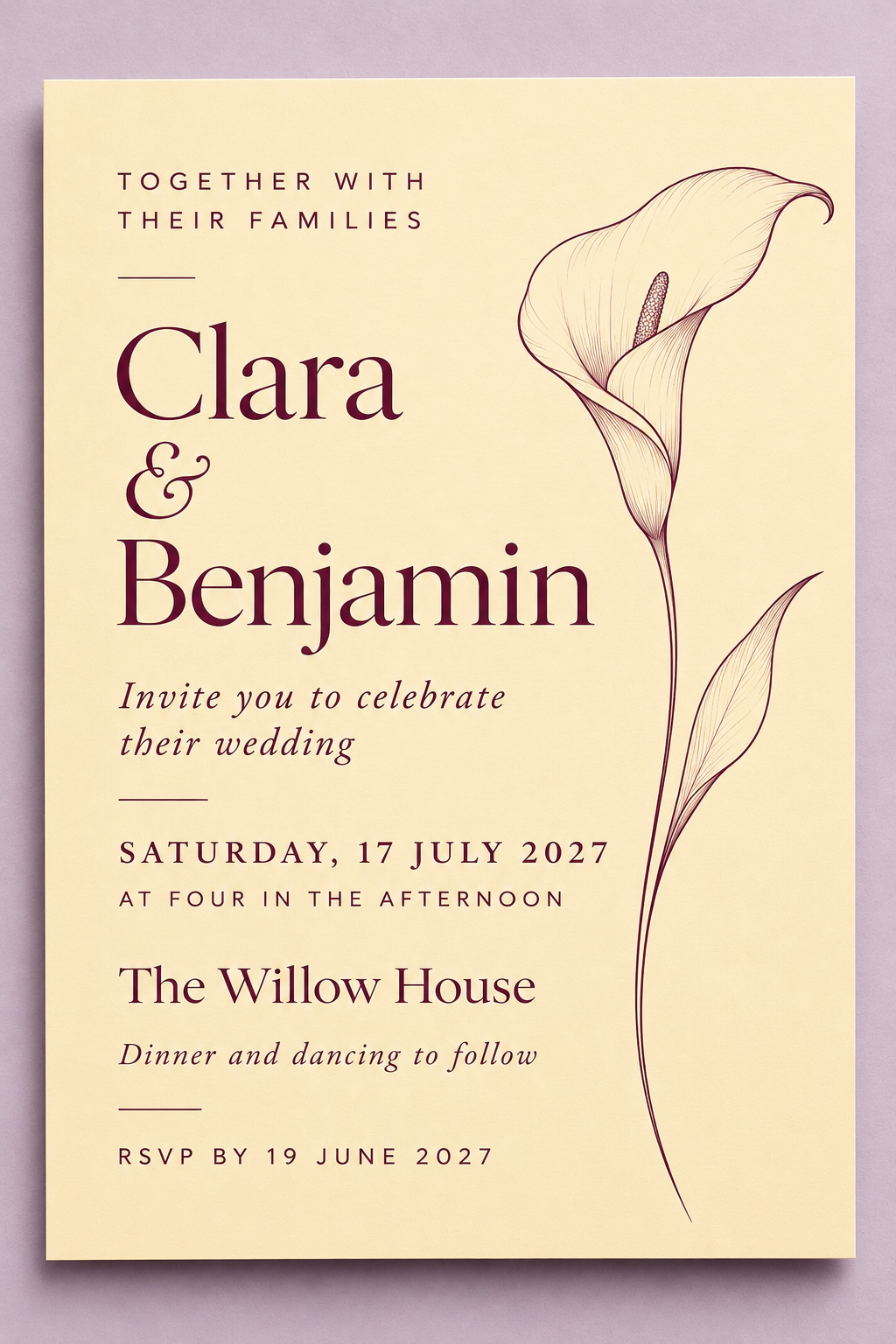
Imagine a portrait invitation featuring a single calla lily drawn in plum ink along the right edge. The couple’s names appear in elegant serif lettering, with the ceremony information arranged in a compact block on the left.
The warm background softens the composition, while the deep illustration colour keeps the flower clearly visible.
Other combinations worth exploring include:
| Background | Illustration colour | Design atmosphere |
|---|---|---|
| Buttercream #F8EDC5 | Deep plum #542D49 | Artistic and romantic |
| Warm white #FAF8F2 | Charcoal #303030 | Contemporary classic |
| Soft lavender #E8E1EF | Aubergine #49364F | Refined and expressive |
| Muted peach #F4D5C4 | Espresso #51382D | Warm and intimate |
| Pale mint #E0EDE5 | Forest green #304E3C | Natural and refreshing |
Use the darker colour for essential wording. Extremely pale lettering can become difficult to read, particularly on textured paper or small screens.
Create Your Own Single Flower Illustration
A personalised botanical sketch can make an invitation more meaningful.
Choose a photograph of a flower you love, preferably one you have taken yourself or have permission to use as a reference.
Sketch its basic outline with a dark pen. Focus on the shape of the petals and the natural direction of the stem instead of reproducing every detail.
Scan the illustration at a high resolution, remove the paper background and place the artwork into your invitation design. A transparent PNG can work for raster artwork, while a vector file provides greater flexibility when resizing.
Try creating three versions of the same flower: a simplified outline, a continuous-line interpretation and a slightly more detailed botanical sketch.
Compare them at the actual invitation size before deciding which one feels right.
Our invitation card maker offers another starting point for exploring invitation layouts.
Wedding Invitation Wording for a Single Floral Design
Short, welcoming wording complements the simplicity of botanical line art.
Here is a fictional example that you can personalise:
Together with their families
Clara & Benjamin
Invite you to celebrate their wedding
Saturday, 17 July 2027
At four in the afternoon
The Willow House
Dinner and dancing to follow
Kindly RSVP by 19 June 2027
For American wedding invitations, the date can be written as July 17, 2027. British couples may prefer 17 July 2027.
For international guests, provide the full venue address and any necessary travel information on a separate details card or wedding website.
Use the Flower Removal Test
Temporarily hide the floral illustration from your invitation design.
Does the typography still look balanced? Can guests identify the names, date and venue without difficulty?
If the layout becomes completely disconnected when the flower disappears, reconsider the positioning of your text.
Restore the illustration and check whether it complements the wording rather than competing with it.
This simple exercise helps establish a strong composition without relying on additional decorative elements.
Preparing Fine-Line Floral Artwork for Printing
Delicate illustrations require careful preparation, particularly when using textured cardstock or specialist printing techniques.
Keep the following considerations in mind:
- Use vector artwork when possible to preserve clean lines at different sizes.
- Aim for 300 PPI at the intended print size when working with raster illustrations.
- Ask your printer about minimum reproducible stroke thickness.
- Keep the flower and essential wording within the recommended safe area.
- Review a printed proof before ordering the complete stationery collection.
A smooth matte finish can help preserve fine artwork. Heavily textured paper may require slightly thicker illustration strokes.
For a digital invitation, check that the flower remains visible and the text remains readable on a mobile screen.
Extend the Illustration Beyond Your Invitation
The same floral sketch can appear on RSVP cards, ceremony programmes, menus and thank-you cards.
Instead of introducing different flowers on every item, use different portions of the original illustration. A small flower head might decorate a place card, while the complete stem could appear on the wedding menu.
Explore our wedding invitation suites guide for more ways to coordinate your stationery.
Frequently Asked Questions
Which flower works best for minimalist wedding invitations?
Calla lilies, tulips, roses and cosmos flowers have distinctive shapes that translate well into simplified line drawings. Choose a flower that complements your wedding aesthetic.
Can I use a single floral drawing for a winter wedding?
Yes. Deep plum, charcoal or evergreen artwork on ivory paper can create an elegant winter invitation without seasonal floral arrangements.
Does a floral line drawing need to be black?
No. Burgundy, brown, forest green and other muted colours can create a beautiful alternative, provided the illustration remains clearly visible.
A Small Illustration With a Personal Meaning
A single floral line drawing gives wedding stationery character without unnecessary complexity.
Choose a flower that connects with your celebration, position it thoughtfully and preserve enough space for readable typography. Whether the illustration is hand-drawn, digitally created or commissioned, its simplicity can become the most memorable feature of your invitation.